Chapter 0: Embers in the Silicon
In 1985, the world was changing; but it wasn’t until 1987 that I truly heard the knock of a new era.
On a sweltering afternoon in 1987, the relentless drone of cicadas outside the computer lab was maddening. I sat before an Apple II, my palms slick with sweat. I typed my very first line of code: PRINT "HELLO WORLD". At that moment, I had no idea I was signing a forty-year contract—a covenant with logic, with silicon, and with an endless stream of bugs that would entangle me for a lifetime.
The high school computer lab of 1987 was a sanctuary. To enter, one had to don a white lab coat and switch into indoor slippers. The air didn’t carry the aroma of roasted coffee; instead, it smelled of floor wax and static electricity.
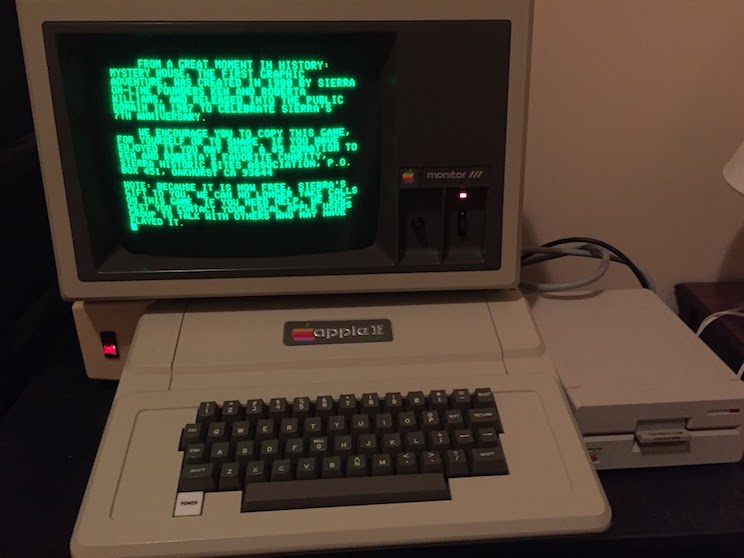
I remember sliding a flimsy 5.25-inch floppy disk into the drive. The machine groaned and clicked, and a green cursor began to blink on the screen. Everyone held their breath in the silence, as if waiting for a sacred ritual to commence. It was a world away from the instant gratification of flipping open a MacBook today. That sense of “anticipation” born from delay is something modern, lightning-fast efficiency has rendered extinct.
The heart of it all was hidden inside a black ceramic square known as the 6502. Back then, it was my God.
10 PRINT "HELLO WORLD"
20 GOTO 10
This was the first infinite loop I ever learned—the beginning of my entanglement with the silicon.
Children today can hardly fathom that this “divine” machine had a clock speed of only 1 MHz. Its memory topped out at 64 KB—in 2026, that wouldn’t even be enough to hold a heavily compressed thumbnail.
Modern developers struggle to grasp the reality of 64 KB of RAM. In 2026, that’s not even enough for a high-definition icon; but in 1987, it was my entire universe.
The eerie green phosphor on the screen looks like an ancient incantation by today’s standards. There were no windows, no mice, and certainly no “undo” key. Every line of BASIC code you typed felt like chiseling characters into solid rock. That austerity brought not just limitations, but a cold kind of freedom—the machine was so simple that you could see through its every vein.
When young people talk about keyboards today, they discuss linear switches, tactile bumps, or the effortless travel of a MacBook. But the tactile feedback of that 1987 Apple II was the opposite extreme: it was stiff, heavy, and echoed with the friction of plastic on plastic.
The keyboard wasn’t actually “good.” When you pressed a key, you could feel the struggle of an inferior spring beneath your fingertip, accompanied by a viscous resistance. If you typed too fast, the 1 MHz 6502 chip couldn’t even keep up with your rhythm. But this taught me to slow down. In an age without a “backspace” that could fix everything, every clumsy press was an irrevocable decision.
In an era where 64 KB was the universe, that stiffness became a footnote to logic itself. In 2026, we squander 16 GB or more without a second thought, doodling aimlessly on silky-smooth trackpads. But in 1987, the price of every line of code was a physical bout between your fingertips and hard plastic.
The green phosphor danced on the screen, its ghostly trails intertwining with the mechanical thrum of the keyboard. Amidst the whirring of the floppy drive, I realized for the first time: Writing code wasn’t a lighthearted act of creation; it was an ascetic practice called “Logic,” performed on crude equipment with agonizingly limited resources.
Yet, on that machine, we learned the true meaning of efficiency. Because resources were finite, every line of code had to be as precise as a surgeon’s scalpel. Within that 140 KB floppy disk, we packed the logic of an entire world and all the ambitions of that era.
I remember my most extravagant dream wasn’t a faster processor, but a more comprehensive Apple II Reference Manual. Within those dog-eared pages lay the secret ciphers to the digital wilderness. Compared to the tens of thousands of pages of API documentation we have now, the logic back then was pure—so pure it was terrifying.
I can safely say I was the only kid in school who owned that manual. It cost me a week’s worth of lunch money, bought at a place called “Xinhua Bookstore.”
Many ask me: why look back at a clunky machine from 1987 in the year 2026?
Because modern M5 chips are too cold, too perfect. They trick you into believing that logic is a given. But in the green glow of that Apple II, I saw logic in its rawest, most burning form.
It is a spark—an Ember in the Silicon. It has been burning in my heart for over forty years, and it hasn’t gone out yet.